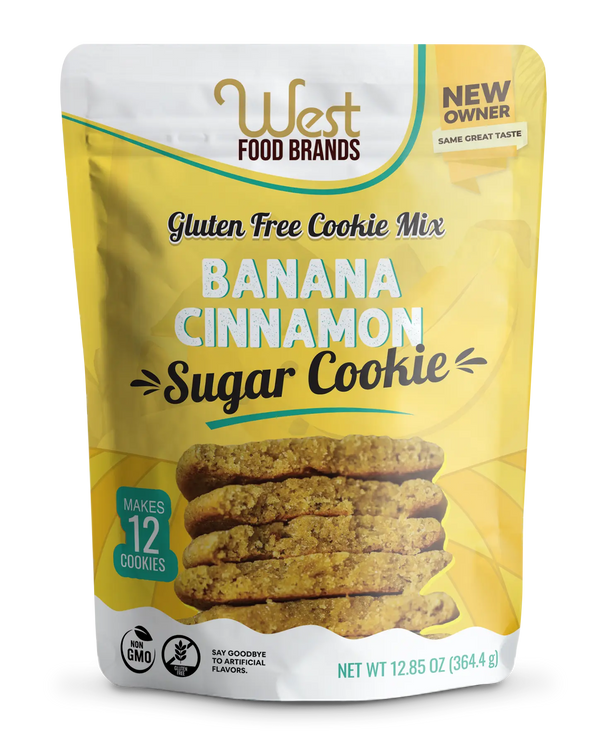
TL;DR: To make gluten free cookies, replace the wheat flour with a gluten free flour blend, add a binder like xanthan gum or a flax egg so the cookies hold together, and do not overbake. The simplest path is to start from a certified gluten free cookie mix, which already has the flour, starch, and binder balanced, so you just add butter and an egg and bake at 350°F for 10 to 12 minutes. The West Food Brands Banana Cinnamon Sugar Cookie Mix takes the guesswork out.
Making cookies gluten free is not as simple as swapping flour one for one, because wheat flour does two jobs at once: it provides structure and it holds moisture. Remove the gluten and the cookie can crumble or dry out. Here is how to convert a recipe, what flours and binders to use, and the fastest way to skip the trial and error.
How do you make gluten free cookies from scratch?
You swap the wheat flour for a gluten free blend, add a binder, and adjust the moisture and bake time. The flour and binder are the two changes that matter most, since they replace what gluten normally does. A reliable approach looks like this:
· Use a cup-for-cup gluten free flour blend in place of the wheat flour.
· Add 1/4 teaspoon of xanthan gum per cup of flour if your blend does not already include it.
· Add a little extra moisture, such as an egg yolk or a tablespoon of milk, since gluten free flours absorb more liquid.
· Chill the dough for 30 minutes so the flour hydrates and the cookies spread less.
· Bake at 350°F and pull the cookies while the centers still look soft.
That covers most drop cookies. From there you can adjust sugar and fat to fine-tune the texture.
What is the easiest way to make gluten free cookies?
Start from a certified gluten free cookie mix. A mix has already solved the two hardest parts, the flour blend and the binder, so you do not have to source several flours or measure xanthan gum. You add softened butter and an egg, stir, scoop, and bake at 350°F for 10 to 12 minutes. This removes the trial and error that makes from-scratch gluten free baking frustrating, and it gives a consistent result every time. For someone new to gluten free baking, a mix is the most reliable starting point.
What flour do you use to make cookies gluten free?
Use a blend, not a single flour, because no one gluten free flour does everything. The best results come from a base flour, a starch for tenderness, and a binder. Here is how common options compare:
|
Flour or blend |
Role |
Notes |
|
Cup-for-cup GF blend |
All-in-one |
Easiest, often includes xanthan gum |
|
Rice flour |
Base |
Neutral, can be gritty alone |
|
Almond flour |
Base |
Adds fat and chew, denser cookies |
|
Tapioca or potato starch |
Tenderizer |
Lightens and softens texture |
A pre-made mix combines these in the right ratio, which is why it is the most consistent choice.
What can you use as a binder in gluten free cookies?
Use xanthan gum, a flax egg, or an extra egg yolk to replace the structure gluten provides. Without a binder, gluten free cookies tend to fall apart. Xanthan gum is the most common, at about 1/4 teaspoon per cup of flour. A flax egg, made from 1 tablespoon of ground flaxseed and 2.5 tablespoons of water, both binds and adds moisture, which makes it a good choice for vegan cookies. A certified mix already includes a binder, so you do not need to add one.
How do you make gluten free cookies vegan too?
You remove the dairy and the egg on top of the gluten. Use vegan butter or coconut oil for the fat, and a flax egg for the bind and the egg's moisture. Because the flax egg doubles as a binder, vegan gluten free cookies often hold together well and turn out soft. Keep the bake short and let the cookies cool fully before moving them, since the flax bind sets as they cool.
How do you keep gluten free cookies from being dry or crumbly?
Dry and crumbly are the two most common problems, and both come from moisture and bake time. A few fixes solve almost all of it:
· Do not overbake. Pull the cookies at 10 minutes while the centers look soft, since they firm as they cool.
· Add moisture if the dough looks dry, one tablespoon of milk or plant milk at a time.
· Make sure there is a binder, since crumbling usually means too little bind.
· Store the cookies with a slice of bread to keep them soft for days.
Getting these right is the difference between a sandy cookie and a soft, chewy one.
Are homemade gluten free cookies safe for celiac disease?
They are when every ingredient is gluten free and you avoid cross contamination. Certified gluten free flours and mixes are tested to contain less than 20 parts per million of gluten, the threshold the U.S. Food and Drug Administration sets for that label. Watch for hidden gluten in add-ins like some chocolate chips, oats that are not certified, and flavorings, since gluten hides in more than just flour, according to the Celiac Disease Foundation. Baking at home from a certified mix gives you the most control. For the full ingredient list, see what is in our mixes.
Frequently asked questions about making gluten free cookies
Can I use regular cookie recipes and just swap the flour?
Sometimes, if you use a cup-for-cup blend that contains a binder. For best results, also add a little extra moisture and chill the dough, since gluten free flours behave differently.
Do gluten free cookies need xanthan gum?
From scratch, usually yes, unless your flour blend already contains it. A mix includes a binder, so you do not need to add any.
Why do my gluten free cookies spread too much?
Warm butter is the usual cause. Chill the dough for 30 minutes before baking so the cookies hold their shape.
Can I make gluten free cookies without a special flour?
You need some kind of gluten free flour, but it can be a single ingredient like almond flour for certain recipes. A blend gives the most cookie-like result.
Are gluten free cookies healthier?
Not by default. Gluten free means safe for a gluten free diet, not lower in sugar or calories. A cookie is still a treat.
How long do homemade gluten free cookies last?
Store them in an airtight container at room temperature for up to 5 days, or freeze them for up to 3 months.
Key takeaways
· To make gluten free cookies, swap wheat flour for a gluten free blend and add a binder so they hold together.
· Add extra moisture and do not overbake, since gluten free flours dry out faster.
· Xanthan gum, a flax egg, or an extra yolk all work as binders.
· A certified gluten free cookie mix is the easiest, most consistent route.
· Watch for hidden gluten in add-ins, and choose certified ingredients for celiac disease.
Want to skip the trial and error? Try the Banana Cinnamon Sugar Cookie Mix or see our tips for soft and chewy gluten free cookies.
Trusted sources
· U.S. Food and Drug Administration: Gluten-Free Labeling of Foods
· Celiac Disease Foundation: Sources of Gluten
· National Institute of Diabetes and Digestive and Kidney Diseases: Celiac Disease
Harvard T.H. Chan School of Public Health: Celiac Disease and the Gluten Free Diet